

Cloud Migration Checklist
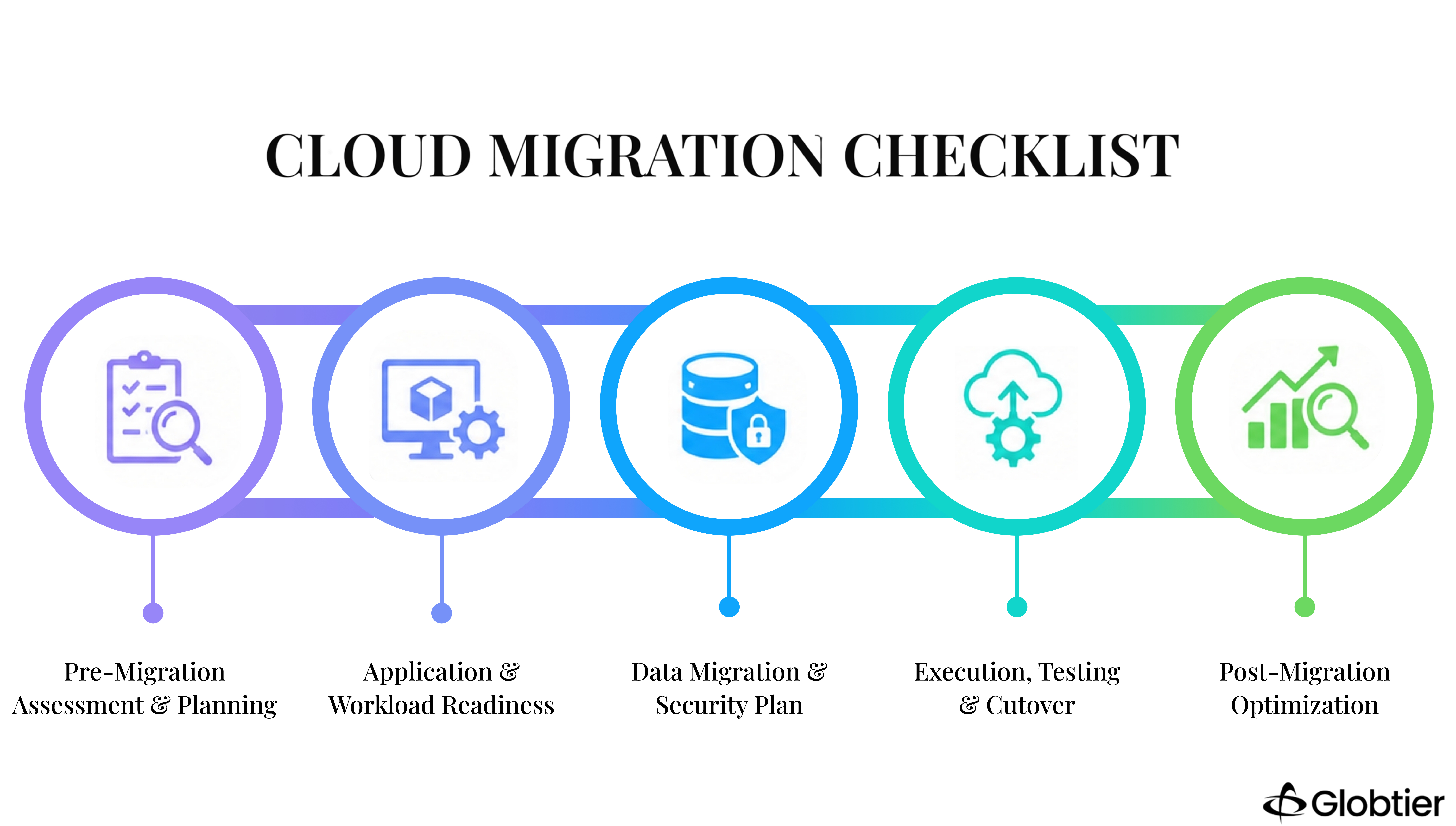
A thorough cloud migration checklist outlines practical processes such as pre-migration assessment, workload readiness, data preparation, and post-launch optimization, all designed to improve your efficiency. With proper structuring, your team is prepared for the new environment, downtime is prevented, and critical data remains protected.
1. Pre-Migration Assessment & Planning
Establish Business Objectives: Identify the exact reasons for the migration (such as scalability, affordability, and agility) and provide measurable KPIs to monitor progress.
Build Your Team: Put together a cross-functional migration team of system administrators, developers, and security experts.
Choose Your Cloud Provider: Pick a model (public, private, or hybrid) and provider (such as AWS, Azure, or Google Cloud) that best suits your workflow and financial requirements.
2. Application & Workload Readiness
Examine Current Inventory: Keep track of all databases, apps, and related data sources. To map what moves together, identify dependencies.
Utilize the “7 R’s” Strategy: Determine which of the following transition paths is ideal for each application: rehost (lift-and-shift), replatform, refactor (re-architect), repurchase, relocate, retire, or retain.
Assess Resource Requirements: Examine past performance indicators to make sure you have the right cloud compute, memory, and storage setups.
3. Data Migration & Security Plan
Implement Strict Security (IAM): Set up role-based access restrictions, multifactor authentication (MFA), and least-privilege principles in identity and access management (IAM).
Bake-In Compliance: Verify that the new environment conforms with all applicable legal frameworks (e.g., GDPR, SOC 2, HIPAA).
Encrypt all data while it’s in transit and at rest to protect it. Prior to any transfers, make a complete, confirmed backup of any important data.
4. Execution, Testing & Cutover
Execute Test Migrations: To simulate the move, set up a test environment. Perform user acceptance testing (UAT), load/stress testing, and functional testing.
Plan Cutover Window: To reduce user downtime, schedule the actual production cutover for off-peak times.
Create a Fallback Plan: Create a well-defined rollback strategy in case there are serious problems with migration.
5. Post-Migration Optimization
Monitor and Benchmark: Keep a close eye on query speeds and latency in the live environment.
Right-Size Resources: Use autoscaling to reduce waste and modify resource sizes to meet real demand.
Train Your Team: To ensure that your team is comfortable handling the new cloud environment, make sure they receive continuous support and operational training.

Author
Sanskriti Shukla
Head - Marketing & Communications